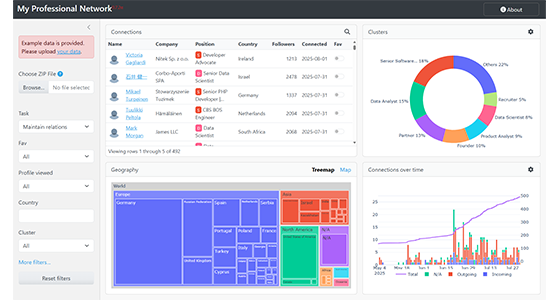
The My Professional Network app is no longer running. This post explains why, what happened to your data, and how to reach me if you’d like to see it return.
Your Feed Is Not Your Network
Have you noticed how your feed shifts over time? Last month you saw a former colleague’s posts every other day. This month they’re gone. Your colleague is still writing — the recommendation system simply decided you should be reading something else.
Over the past year my LinkedIn feed changed direction several times. Some of those shifts introduced me to new people, which is good. But each one also quietly pushed out people I’ve known for years. The feed optimizes for engagement; it has no concept of a relationship worth keeping.
What I Built
Last year I built My Professional Network, an app that takes the LinkedIn data export and turns it into something you can actually navigate: connections clustered by role and location, a map of where your network lives, and favorites so valuable contacts don’t drift out of sight.
I still think the idea is a good one. What I didn’t have was time, and the app never made it past alpha.
Why It’s Shutting Down
The honest answer is that the architecture outgrew the product.
Having worked with high-load systems, I built it the way I’d build for production traffic: horizontally scalable workers, a load balancer with sticky sessions, Redis-backed caching, a Celery task queue, and a local embedding service designed to run on dedicated hardware with multi-core CPUs and GPUs. Embedding thousands of job titles took a fraction of a second. From an engineering standpoint, I was proud of it.
But that same design created a hard dependency on that hardware. The services were tightly coupled to it, so there was no cheap way to scale the system down — collapsing it into one or two containers on an inexpensive cloud tier wasn’t possible without a substantial rewrite. Keeping it alive meant paying for infrastructure sized for thousands of users while serving a handful.
At the same time, taking the app to a paid product would have competed directly with my current client work and other projects. Faced with a rewrite I couldn’t prioritize or ongoing costs I couldn’t justify, I’ve decided to officially shut it down.
Scalability is not the same as the ability to scale down. For an early-stage product, the more valuable property is elasticity in both directions: start on the smallest footprint that works, and keep a clear path to the architecture you’ll need once users actually arrive. I designed for the second stage and skipped the first.
What Happened to Your Data
Nothing to worry about here. The app never stored your LinkedIn export or the connection data derived from it. Everything was processed for your session only.
The only thing kept was your favorites list, and it was stored in encoded form. If you’d like it back, just ask and I’ll recover it for you.
Will It Come Back?
Maybe. The core problem hasn’t gone away, and the analytical pipeline — semantic clustering of job titles, geographic grouping, contact prioritization — still works. What it needs is a leaner deployment and a clearer picture of who would use it and for what.
That’s where you come in. If you used the app, or if you just think the idea is worth pursuing, I’d like to hear from you:
- What did you use it for? Which feature mattered, and what was missing?
- Would you pay for it? As an individual, or as a tool for a recruiting, sales, or community team?
- Interested in backing it? If you’d consider funding, partnering on, or sponsoring a relaunch, I’d especially like to talk.
The easiest way to reach me is to connect on LinkedIn — mention the app in your note so I know where you’re coming from.
Thank you to everyone who tried it during the alpha.
See Also
Here are some related posts you might find interesting: